


SENTIERO DEGLI DEI
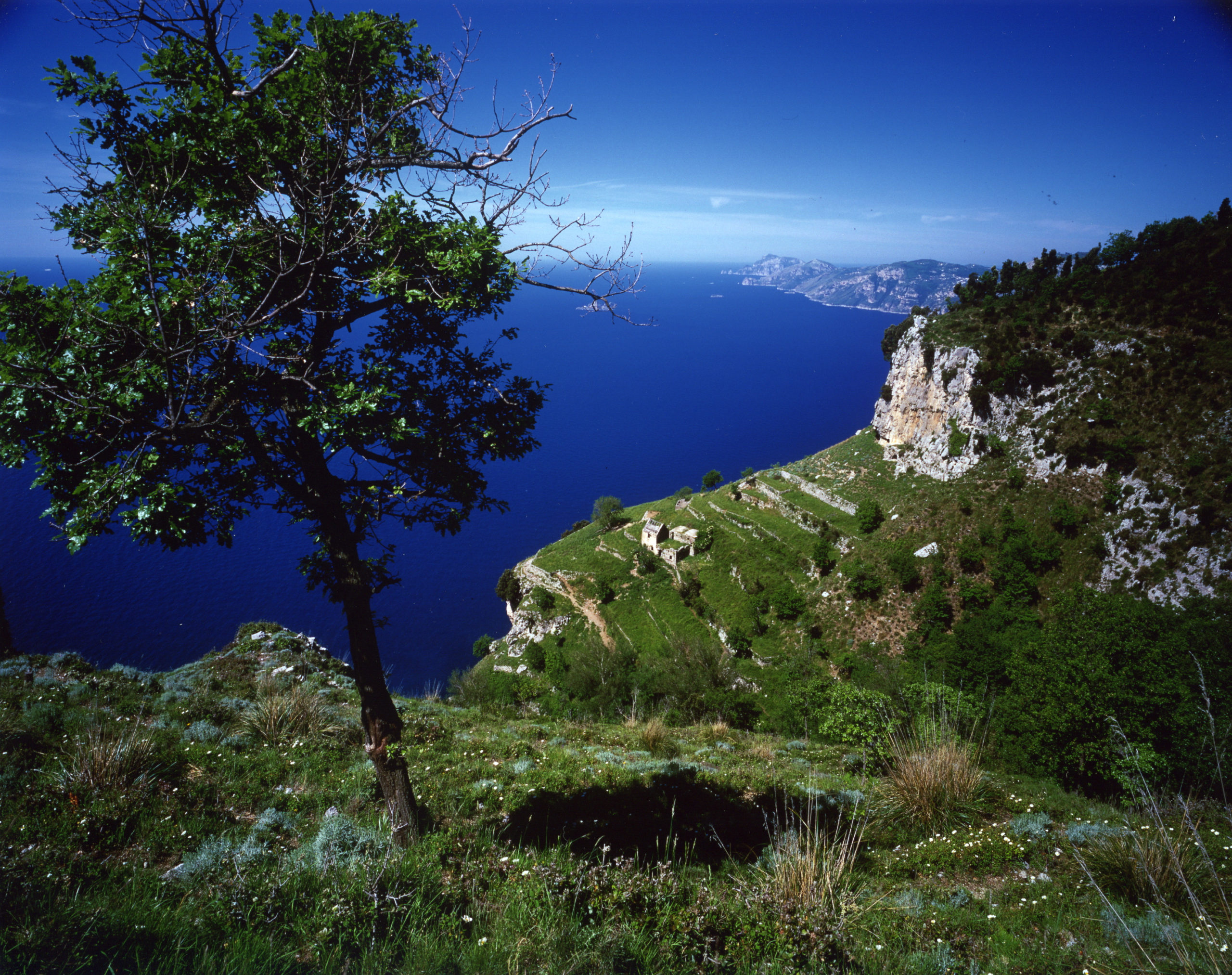
The Path of the Gods, ranked among the top ten most beautiful trails in the world, is the most popular route in the area. Following gentle paths flanked by spectacular cliffs and passing through various gorges, the trail offers unrivalled views of Positano, the Sorrento Peninsula, the Galli islets and Capri. The vegetation, the terraced fields and the ancient rural buildings dotted along the route are also of great interest.
Information about the route
From Piazza Paolo Capasso in Bomerano, follow the downhill lane Via Pennino. After approximately 300 metres, at a series of stone steps, turn right and cross a wooden bridge.
Continue uphill along the staircase until you reach a paved road. Turn left and follow it until it becomes a concrete mule track. After a bend descending downhill, you will arrive at Grotta del Biscotto.
The route continues along a dirt path with gentle ascents and descents, leading to Colle la Serra Pass (580 m). Near the ruins of an old building, the trail splits into two equally scenic alternatives that rejoin later at Cannati (560 m):
- Upper Route (right): begins with a rougher section but rewards hikers with views of ancient lime kilns, once used for lime production.
- Lower Route (left): starts with a descent and includes several exposed sections. Along this path, a junction on the left leads down to the picturesque Convent of San Domenico and then to Vettica Maggiore. This option is recommended for those wishing to enjoy a shorter hike.
From Cannati, the trail continues through a series of gentle ups and downs, crossing the Gradelle Valley before reaching the hamlet of Nocella (420 m) after approximately 2 kilometres.
At the small chapel depicting the Crucifixion and the nearby fountain, turn right and follow the narrow lane until it joins the main road, which leads to the village of Montepertuso in about 1 kilometre.
About 100 metres beyond the village square, a staircase on the left descends directly to the centre of Positano.
Alternatively, from Nocella, you can follow the famous staircase of approximately 1,700 steps leading down to Arienzo, on the former State Road 163 (Amalfi Drive). Turning right and following the road for about 500 metres (please be aware of vehicle traffic), you will arrive in the centre of Positano.
Return Journey
To return to Agerola, you can take a SITA bus from Positano, changing buses in Amalfi. During the summer months, another enjoyable option is to travel by sea to Amalfi using the Metro del Mare (Sea Metro) service or one of the regular ferry connections, before continuing to Agerola by bus.
Highlights & Points of Interest
The impressive rock face of Grotta del Biscotto is composed of ancient cemented debris dating back to the late Pliocene. These deposits originated from Monte Tre Calli and from a mountain that once stood to the south before gradually sinking due to tectonic activity during the formation of the Gulf of Salerno. Beyond this point, the trail crosses Jurassic marine limestone and dolomite, geological formations that accompany hikers for much of the route.
Below the trail at Grotta del Biscotto, visitors can admire a series of cave dwellings believed to have originally served as hermit cells for the anchorites who, during the Early Middle Ages, were connected to the nearby Church of Santa Barbara. A short distance further on stands the ruin of an ancient farmhouse dramatically perched on the edge of a rocky spur. Other fine examples of traditional rural architecture can be found at Colle la Serra, Cannati, and Nocella.
The landscape also bears witness to centuries of human activity through its remarkable agricultural terraces, supported by traditional dry-stone walls. Where still cultivated, these terraces are home to pergola vineyards producing the renowned “heroic wines” of the Amalfi Coast. At lower elevations, visitors will find lemon groves that produce the famous Amalfi Sfusato Lemon (Limone Costa d’Amalfi PGI), the essential ingredient of the area’s celebrated Limoncello.
The route also showcases the transition between different Mediterranean ecosystems. The mixed woodlands of the upper Praia Valley, particularly on the north-eastern slopes, gradually give way to evergreen holm oak forests, Mediterranean scrub and rocky garrigue vegetation. During spring, the trail is enriched by colourful blooms, including the endemic Santolina, Myrtle, white and pink Rockrose (Cistus), Broom, and Rosemary.
The true highlight of this hike, however, is the extraordinary landscape itself. A continuous succession of cliffs, rocky pinnacles, ledges and deep gorges creates one of the most spectacular settings of the Amalfi Coast. Around every bend, hikers are rewarded with breathtaking panoramas: sweeping views of the dramatic coastline from Positano to Punta Campanella, with the island of Capri rising in the background, alongside unique bird’s-eye views of picturesque villages, secluded bays and rugged headlands that make this stretch of coastline world-famous.