


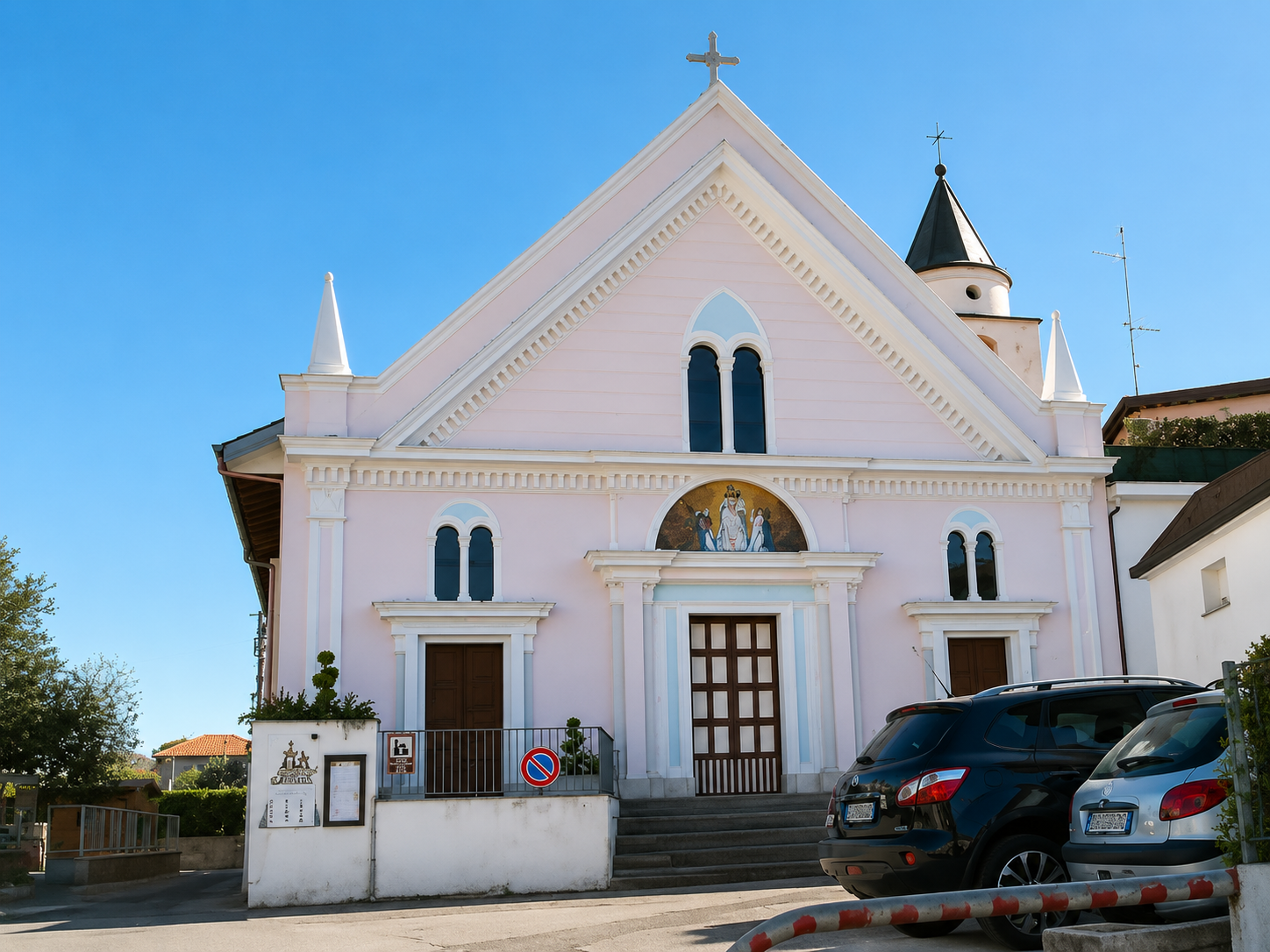
CHIESA TUTTI I SANTI
Information Sheet
📍 Location: Pianillo, Agerola (NA), Italy
⛪ Dedicated to: All Saints
📅 Period: Uncertain origins (probably dating back to the 15th century)
🎨 Style: Local religious architecture with Neoclassical elements
⭐ Highlights: Fresco of Our Lady of Grace, decorated 19th-century wooden ceiling, 1805 painting of Our Lady of the Rosary.
Description
The Church of All Saints preserves one of Agerola’s most valuable artistic treasures: a fragment of a fresco depicting Our Lady of Grace (Madonna delle Grazie), attributed to a late Gothic painter influenced by the style of Giovanni da Gaeta.
In 1625, the fresco was carefully detached together with part of the original masonry and incorporated by the painter Michele Ragolia into his altarpiece depicting Saint Peter the Pope and Saints, ensuring its preservation for future generations.
At the centre of the church’s ceiling is a painting dated 1805, portraying Our Lady of the Rosary with Saint Dominic and Saint Rose. Although modest in artistic quality, the work is of considerable historical importance because it also depicts members of the Confraternity of the Holy Rosary, an association that remains active to this day.
Another remarkable feature is the magnificent 19th-century wooden ceiling, richly decorated with carved grapevine motifs. Hidden for many years beneath a later painting illustrating episodes from the lives of various saints, it was rediscovered and carefully restored during conservation work carried out in recent decades.
Today, the Church of All Saints remains an important place of worship and a precious repository of Agerola’s artistic and historical heritage, bearing witness to the deep religious traditions of the local community.
Did You Know?
The origins of the Church of All Saints are still shrouded in mystery. Historical sources suggest that a small chapel dedicated to the Virgin Mary already stood on this site during the second half of the 15th century.
The discovery of the late Gothic fresco supports this early dating, although historical documentation remains scarce until the 19th century, when the church was enlarged and enriched with its elegant wooden ceiling.
A comprehensive restoration completed in recent years has returned the church to its former beauty, enhancing both its architectural features and its valuable artistic heritage.